What it is
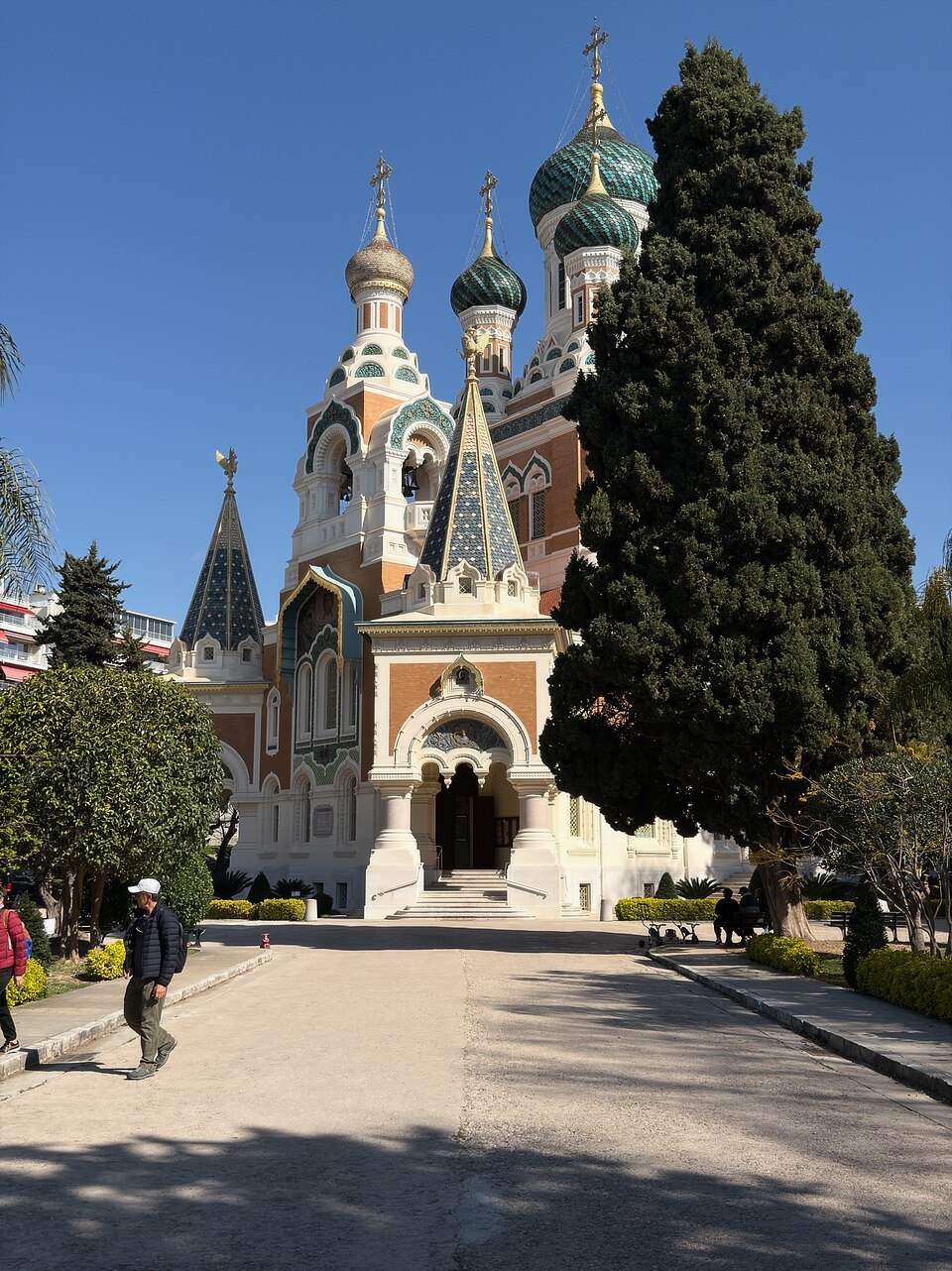
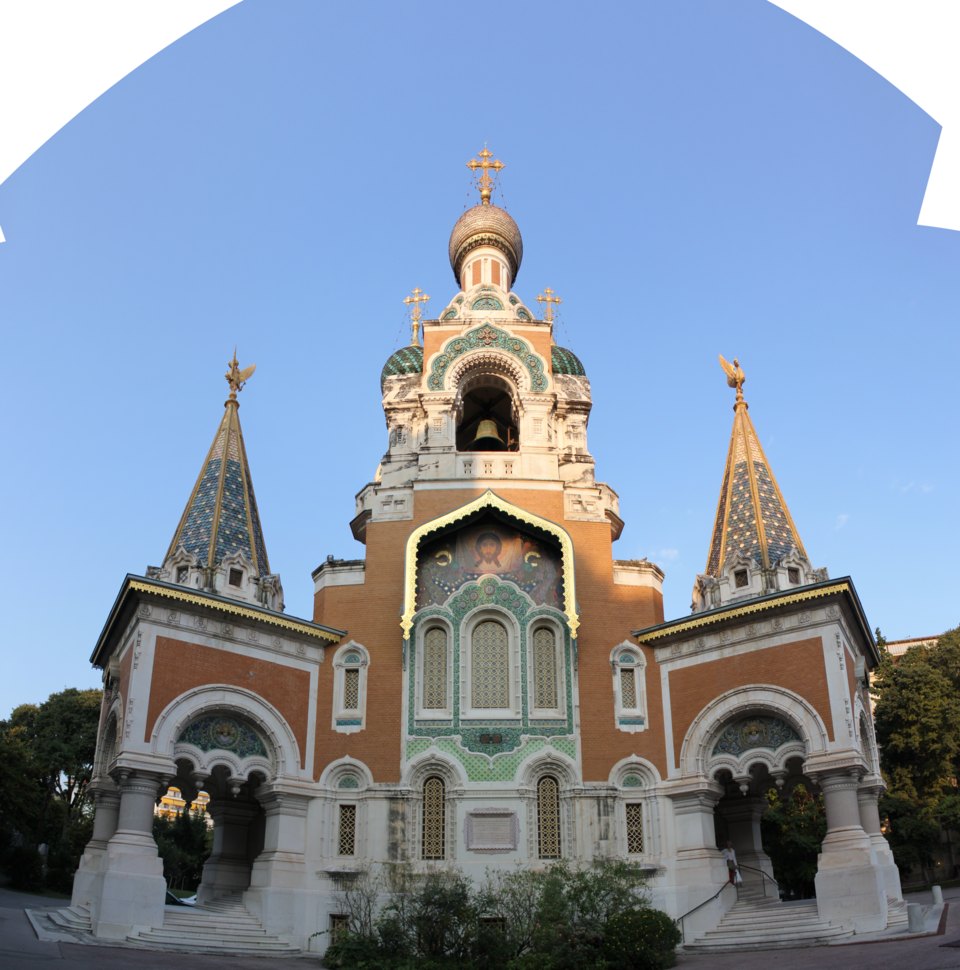
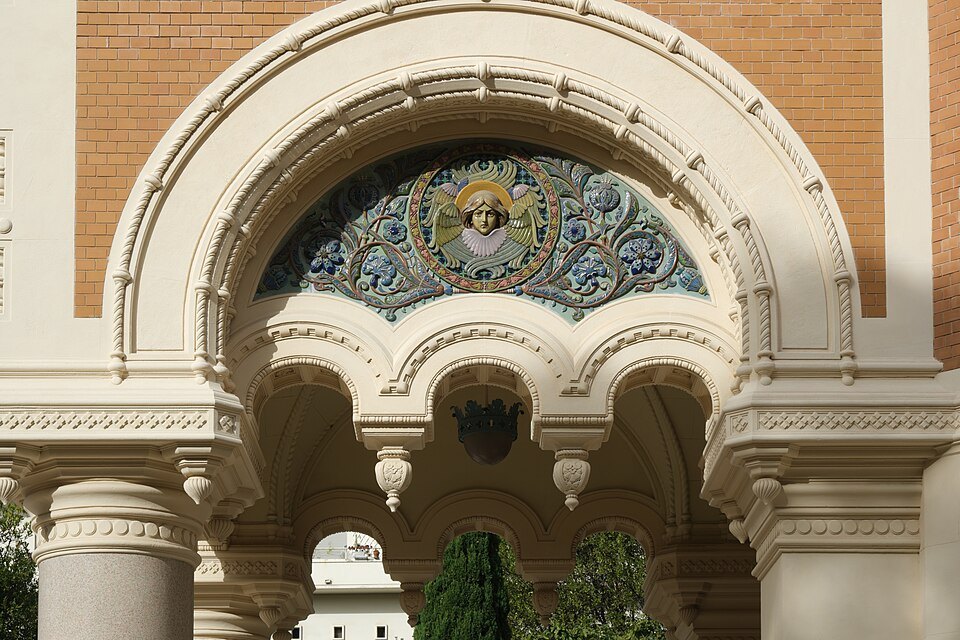
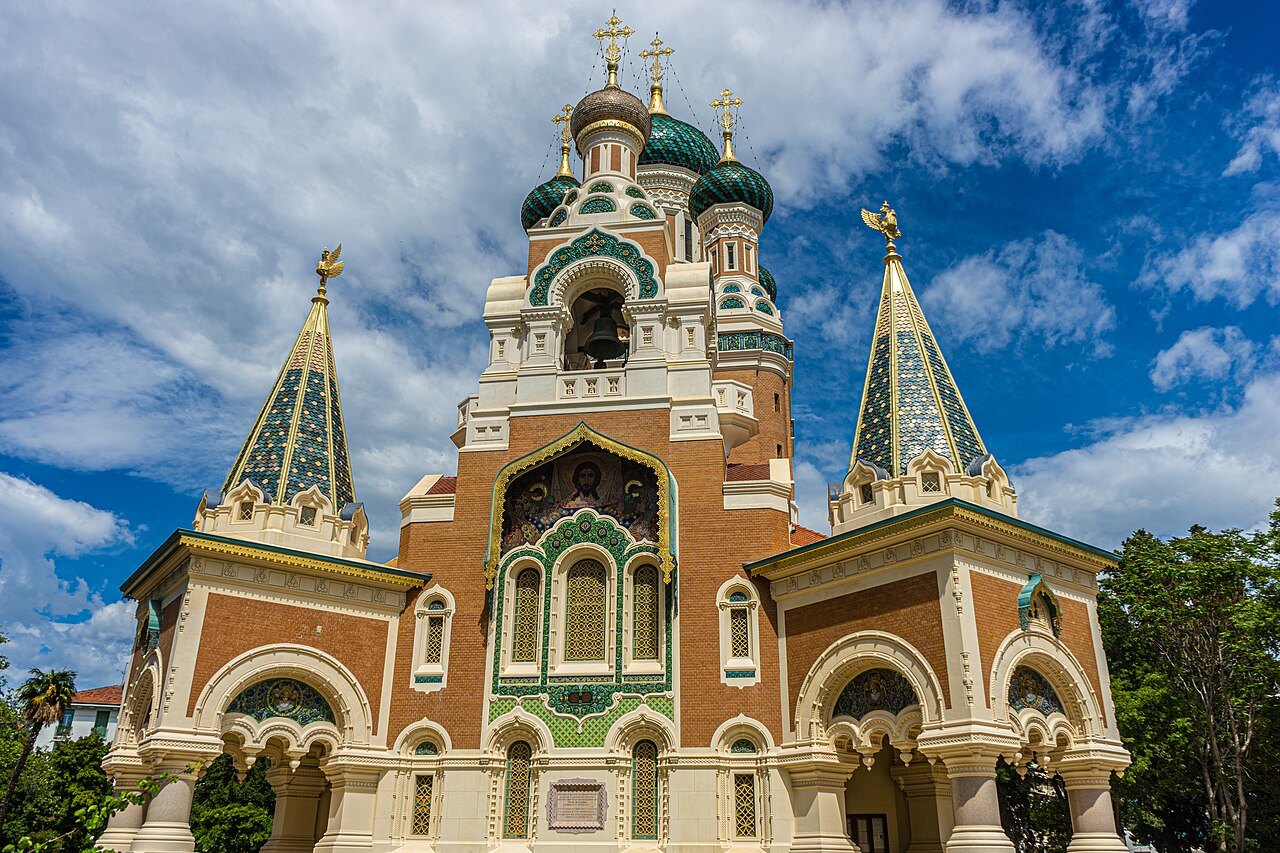
Saint-Nicolas is a full-scale Russian Orthodox cathedral, standing in a quiet street north-west of the station: pink brick, grey granite, majolica tiles and six onion domes.
It is here because Nice's winter colony was not only English. The Russian aristocracy wintered on this coast in numbers through the nineteenth century, and the imperial family paid for a church large enough for them. It was consecrated in 1912, two years before the war that ended that world.
Seeing it
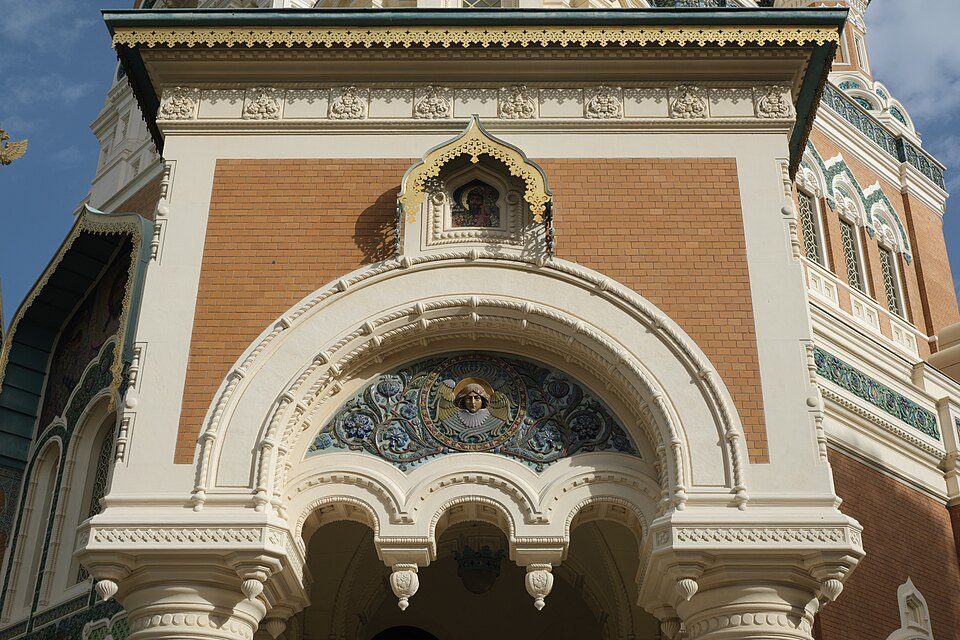
The exterior is the reason to come — it is startling in a French street, and the detail repays a slow walk round the outside.
It is a working church and the interior is treated as one. Dress and behaviour are expected to match.
How the Russians came to Nice
The Russian link with this coast began with the navy. In 1770 Prince Alexei Orlov, commanding a Russian fleet bound for Turkish waters, put in at the bay of Villefranche next door, and he came back in 1781 for his wife's health: from the start, the navy and the climate were the two reasons Russians came. Grand Duke Michael stayed at the Hôtel d'York in 1837, and Nikolai Gogol arrived on December 2, 1843. After the Crimean War the treaty of Paris barred Russia's Black Sea fleet from the Mediterranean, so a supply base for its Baltic ships became essential. From the spring of 1857, under an agreement between the Tsar and the King of Sardinia, the Russian fleet used Villefranche as a supply base, an arrangement that survived the French annexation of 1860 and lasted until the revolution of 1917.
The court followed. The Dowager Empress Alexandra Feodorovna, widow of Nicholas I, wintered in Nice from October 1856 and agreed to sponsor a committee to build a Russian church; the Church of Saint Nicholas and Saint Alexandra opened three years later on Rue Longchamp, the first Russian church in Western Europe. In October 1864 Tsar Alexander II arrived, and he and Napoleon III met in Nice that month, the Emperor traveling on the newly opened railway. The imperial family's presence drew many Russians to Nice, and the little church was soon too small for them.
A death in the family
The Tsar's eldest son and heir, the Tsarevich Nicholas Alexandrovich, came to Nice ill in November 1864. His illness worsened into meningitis, and he died at the Villa Bermond on April 24, 1865, at the age of twenty. Alexander II bought the property, had the villa demolished, and built a memorial chapel on the spot where his son's room had been, designed by David Grimm of the Saint Petersburg Academy of Fine Arts. Its first stone was laid on March 2, 1867, and it was consecrated on March 25, 1868. The small chapel still stands beside the cathedral.
The cathedral itself was begun nearby in 1903 to plans by Mikhail Preobrazhensky, also a professor at the Saint Petersburg Academy, with Tsar Nicholas II paying for the work. It was consecrated in December 1912 in memory of the Tsarevich. It is the largest Orthodox cathedral in Western Europe.
What it is made of
The plan is a Greek cross, with a cubic central block 20 meters on each side carrying five domes: one large dome rising to 52 meters and four medium ones, standing for Christ and the four evangelists, in the style of Moscow-region churches of the late sixteenth century. The drums beneath them are pierced by narrow windows framed in majolica, and the domes are covered in glazed tiles in shades of green. Two twin porches are joined by a many-sided bell tower with a gilded dome.
When the foundations were dug, the ground turned out to be poor, so the architect used a reinforced concrete frame to keep costs down, and dressed it in about ten decorative materials: ochre industrial brick from the Rhineland, Italian marble, white limestone from La Turbie for the base, pastel-blue majolica, and polychrome tiles from Florence and Blois.
A cathedral in court
After 1917 the parish broke with Moscow, and from 1931 it belonged to the Russian Orthodox churches in Western Europe under the Patriarchate of Constantinople. In 2006 the Russian Federation claimed the building, on the grounds that the land had belonged to the imperial family and that a 99-year lease signed in 1909 had expired. French courts agreed: a Nice court in 2010, the Aix-en-Provence appeal court in 2011, and finally the Court of Cassation on April 10, 2013. The keys were handed over on December 15, 2011, and the cathedral now belongs to the Russian state and the Moscow Patriarchate.
It reopened to visitors on July 1, 2012, and after a restoration started on its centenary, December 17, 2012, it was officially reopened on January 19, 2016. The cathedral has been a listed historic monument since 1987.
Sources
- Cathédrale Saint-Nicolas de Nice — Wikipédia (French)
- Chapelle du tsarévitch Nicolas Alexandrovitch de Nice — Wikipédia (French)
- Russian Orthodox Cathedral, Nice — Wikipedia