What it is
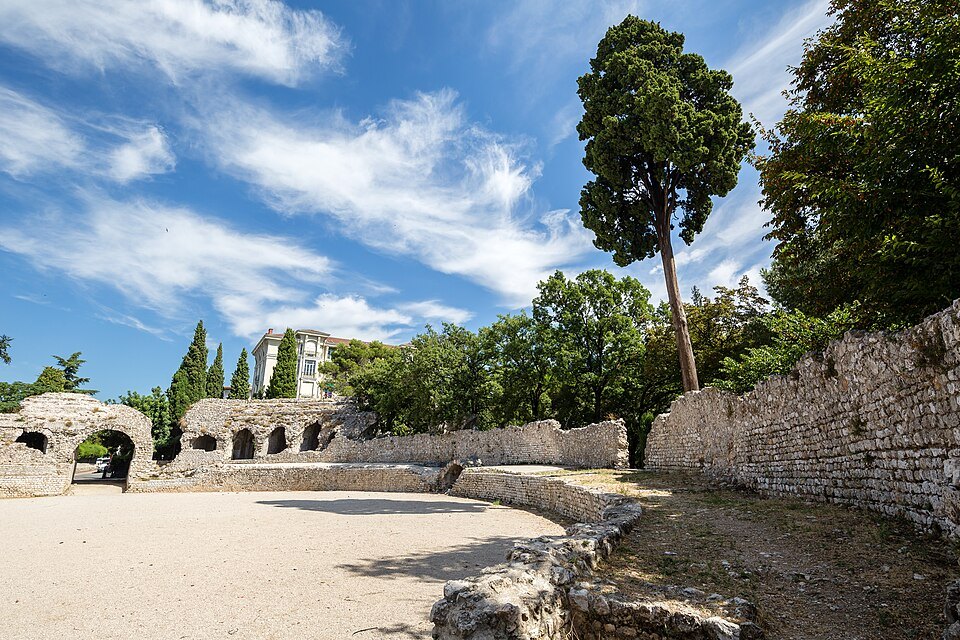
Cimiez is the hill north of the centre, and it holds the remains of Cemenelum, the Roman town that was the capital of the province of the Alpes Maritimae. The arena, the excavated baths and the archaeological museum sit together in one park.
Two settlements, not one: the Greeks founded a port down on the shore, and the Romans built their administrative town up here. Modern Nice grew from the harbour, and Cemenelum was left on the hill — which is why it survived.
What else is up there
The Musée Matisse is in the villa at the edge of the same grove, and the Franciscan monastery and its gardens are a few minutes further on, with a long view back down over the city.
It is a real hill. Buses run up; walking it from the centre is a climb.
Why the Romans chose the hill
When Rome conquered what is now Provence, between 122 and 118 BC, the Romans did not settle beside the Greek trading post of Nikaia on the shore. They established themselves first as a garrison and then as an administration on this height, near the hill fort of a Ligurian people, the Vediantii. Their town, Cemenelum, appears on the Peutinger map, the Roman road map, and became the capital of the province of the Maritime Alps. The Via Julia Augusta, coming down from La Turbie, ran straight through it.
It was a town of some size: an amphitheater, three bath complexes, and probably at least 10,000 inhabitants. A garrison of perhaps 1,000 to 1,500 men was stationed here, and studies of soldiers' gravestones show that Cemenelum sent many recruits to the Roman army. Saint Pons was martyred here in 257; in the eighth century an abbey was founded over his tomb in the Roman cemetery. Cemenelum later lost its role as capital to Embrun, but it lived on: in the fifth century houses replaced the baths, a bishop briefly had his seat here, and people still lived among the ruins into the seventh or eighth century.
The arena
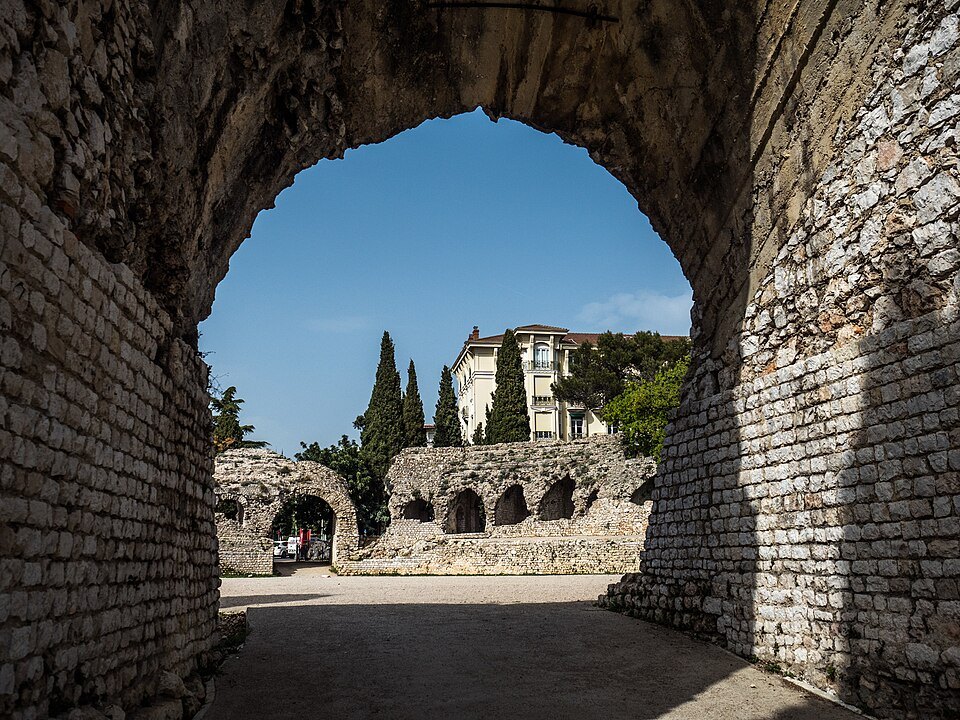
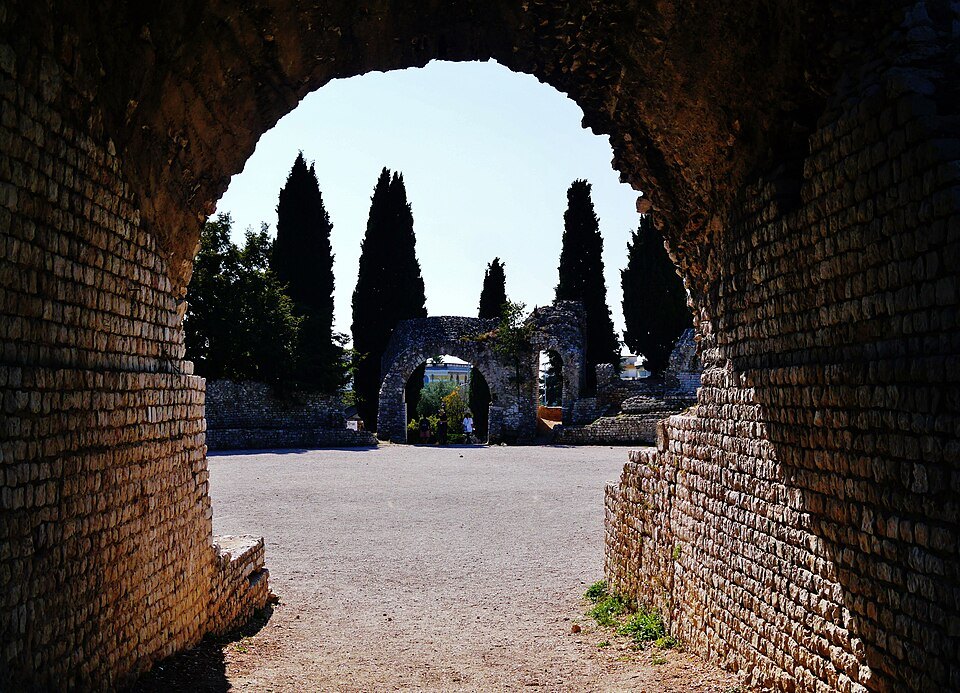
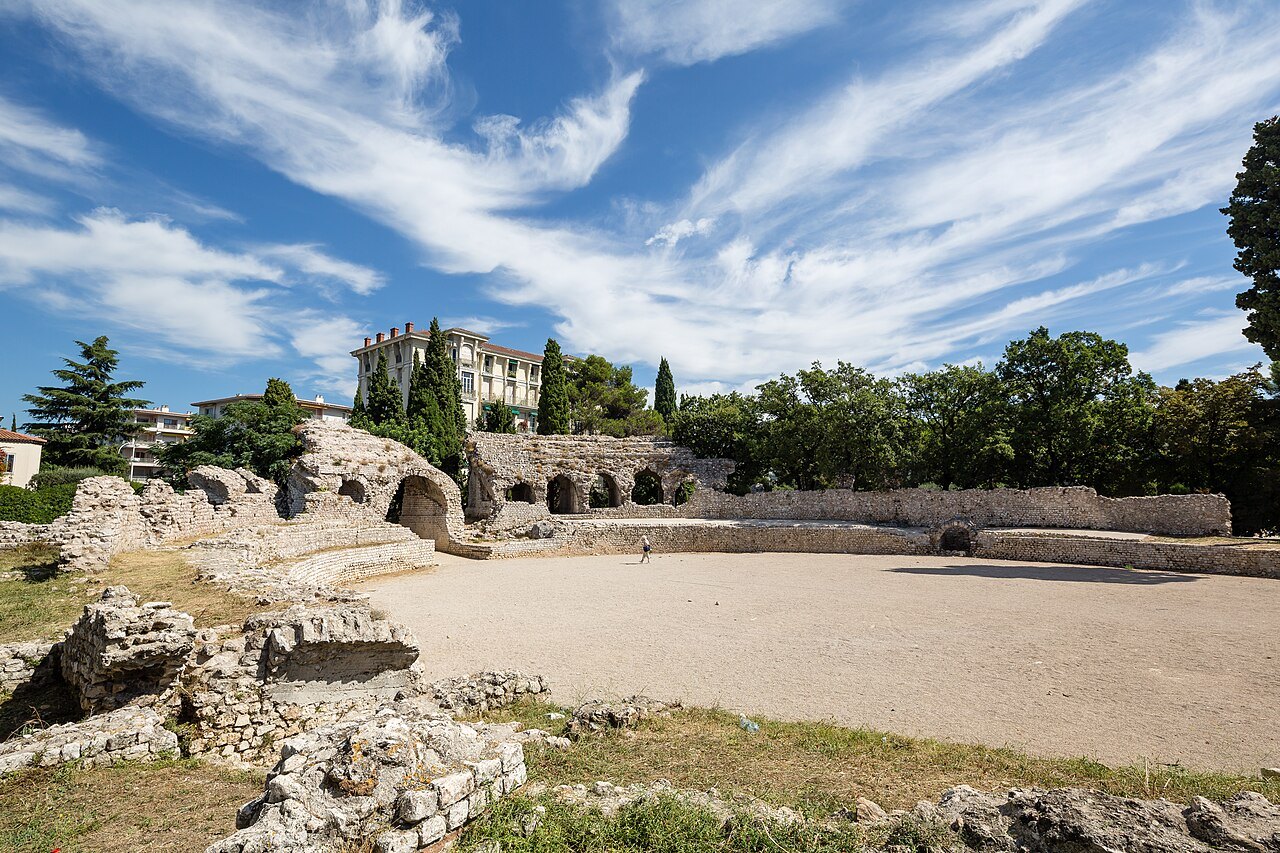
The amphitheater is one of the smallest known in Roman Gaul. It was built in two campaigns between 70 and 80 AD, first as little more than the arena and three rows of seats on banked earth, and was later enlarged with extra tiers reached by a ring-shaped walkway and stairs; the second phase shows bands of brick in the masonry. In its final form it is an ellipse of 67.2 by 56 meters around an arena of 46 by 34.8 meters, holding an estimated 4,000 spectators, and you can still see some of the anchor points for the awning that shaded them.
What it was used for is still debated. Its size once suggested a military training ground for the cohorts stationed here, but there are no cages or pits for animal fights, and it is too small for large gladiator combats. More likely it staged games to entertain the people of the town. It was abandoned by the fourth century; later, a garden and vines grew in the arena and a street ran across it. The podium wall survives around almost the whole arena, as do the north and south entrances. It has been a classified monument since May 13, 1965, and from 1974 to 2010 it hosted the Nice Jazz Festival.
Under the neighborhood
Most of Cemenelum lies under the villas and apartment buildings of Cimiez, and building work often turns up Roman streets or floors. The visible remains, apart from the arena, are reached through the archaeological museum: the three bath complexes, one of them the site of a fifth-century bishop's church with a remarkable early Christian baptistery. On the bath site you can walk along the paved east-west main street, the decumanus, about two meters below today's ground, past shop thresholds with the grooves that held their shutters. Finds from the excavations include a statue of Antonia, mother of the Emperor Claudius.
The ruins have drawn scholars for centuries. In 1559 Michel de L'Hospital noted baths, an aqueduct and what he called a little theater, which was in fact the amphitheater. The architect François Brun drew up a plan of all the remains in 1866, Nino Lamboglia excavated in the late 1930s, Paul-Marie Duval studied the site in 1943, and a new program of excavations began in 2007.
Cimiez in the Belle Époque
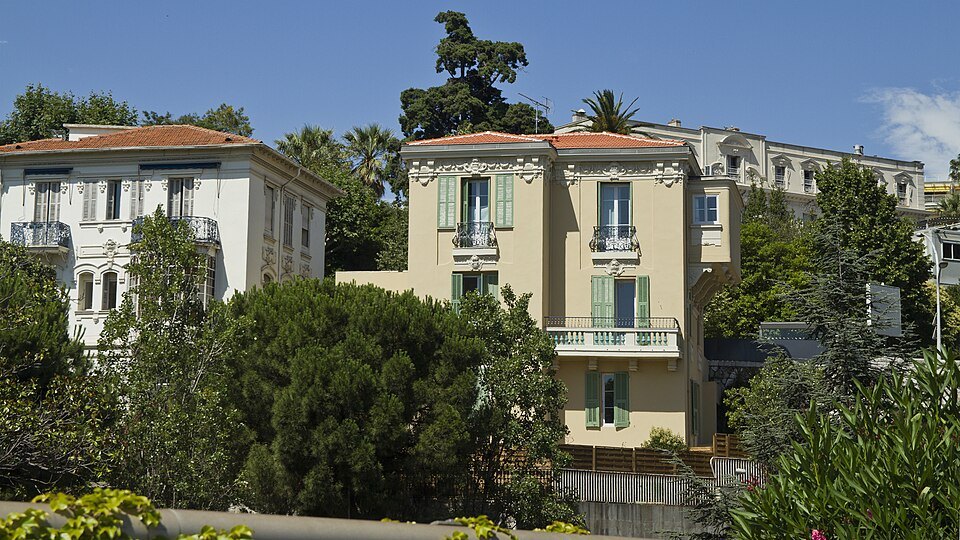
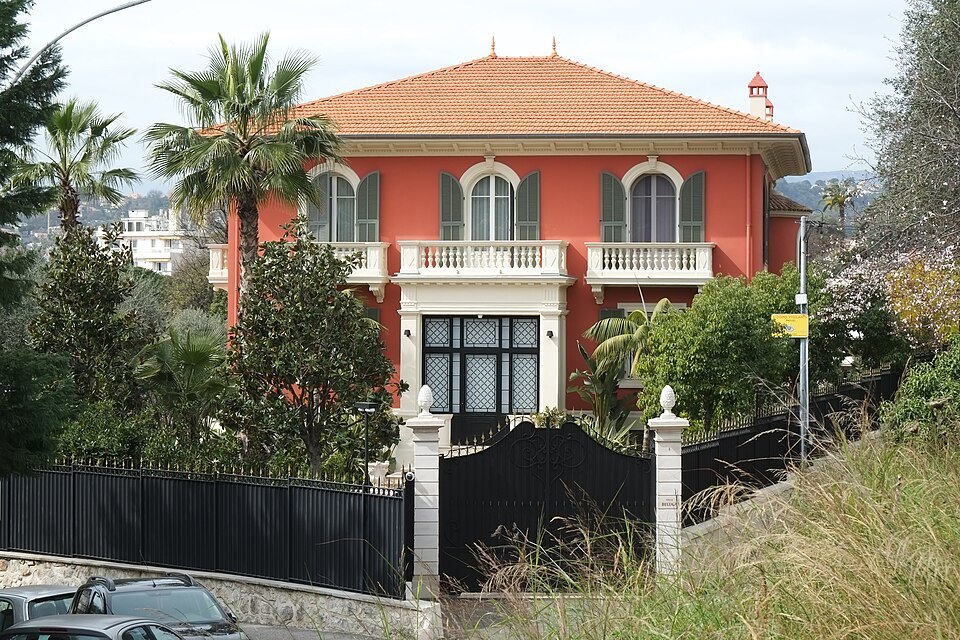
Much later the hill became a favorite resort of European royalty: Queen Victoria, Edward VII, George V and Leopold II of Belgium all stayed in Cimiez, and Victoria spent part of her long visits at the Excelsior Régina Palace near the ruins. Close by, in the cemetery of the Franciscan monastery, are the graves of the painters Henri Matisse and Raoul Dufy and of Roger Martin du Gard, winner of the 1937 Nobel Prize in Literature. The monastery church holds paintings by Ludovico (Louis) Bréa, including a Pietà of 1475.
Sources