What it is
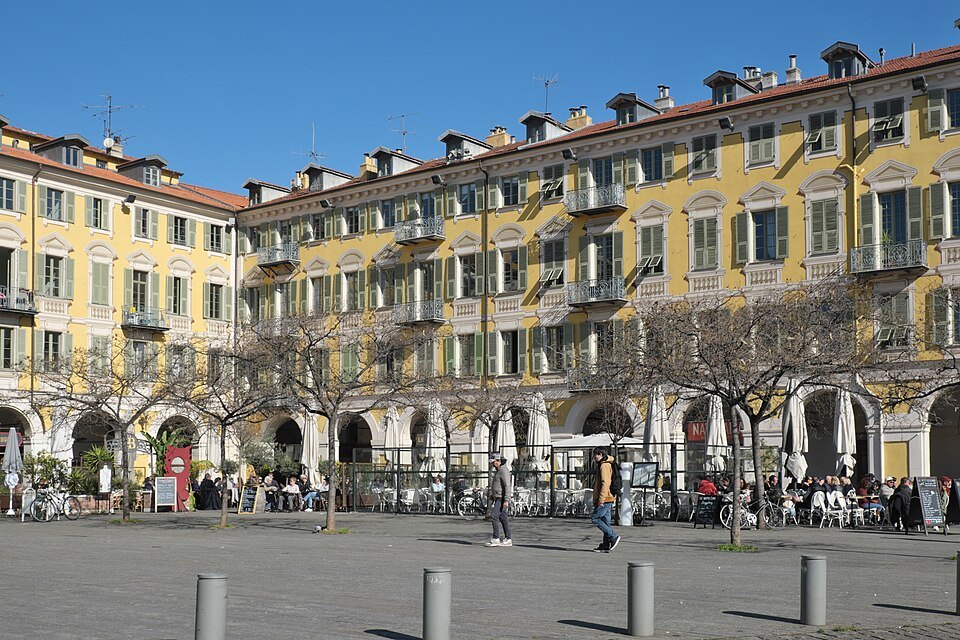
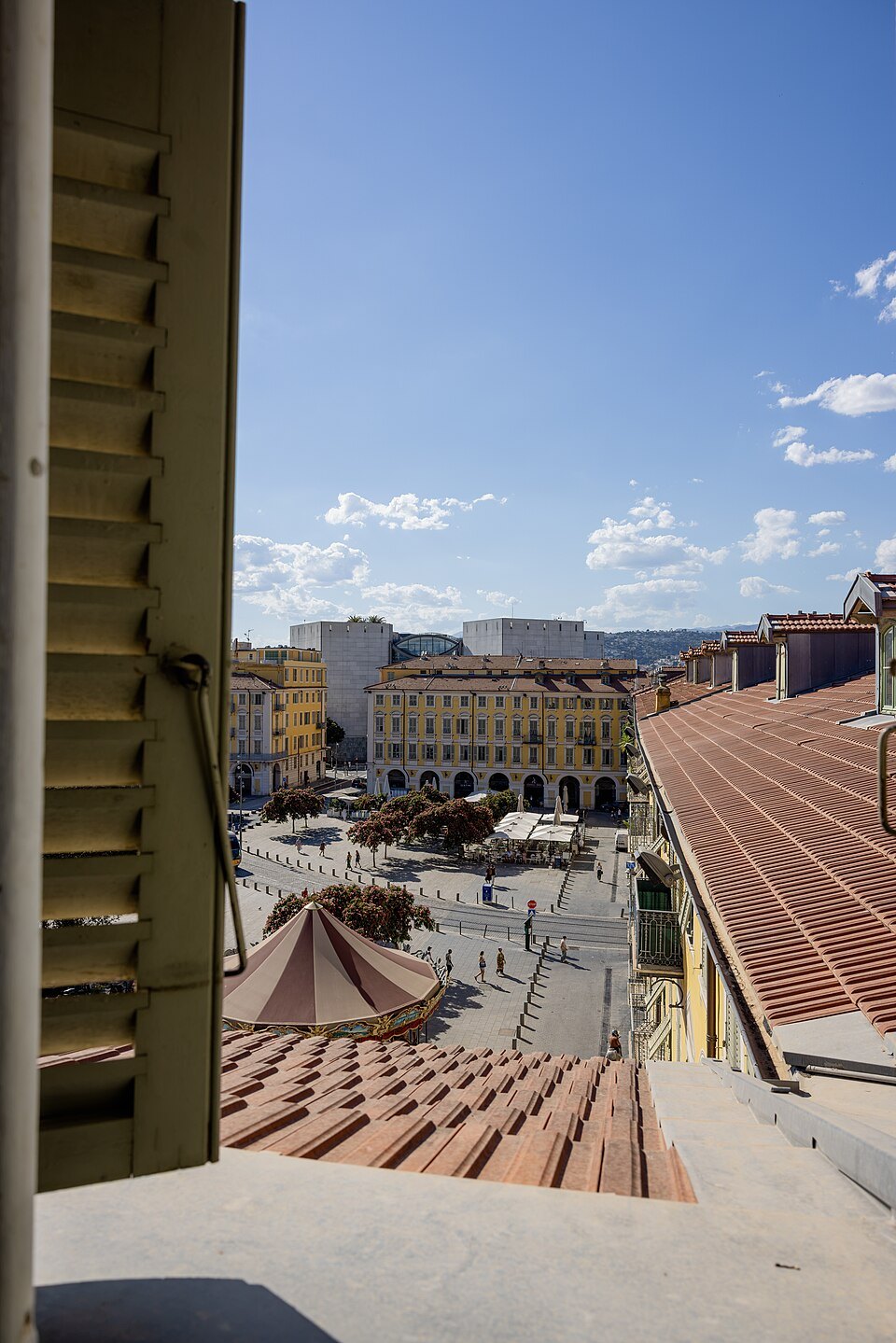
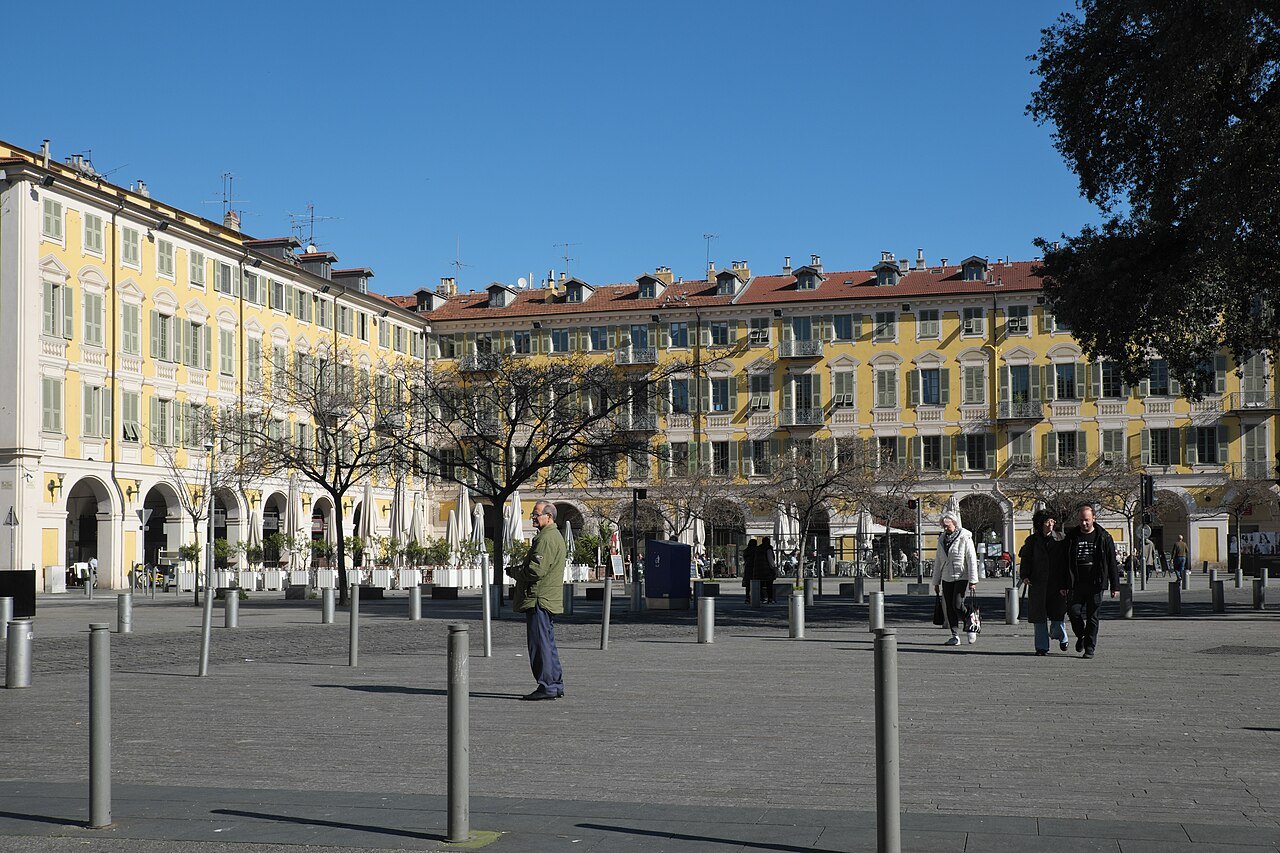
A large arcaded square at the northern edge of the old town, laid out in the eighteenth century when Nice was Sardinian — which is why it looks like Turin: ochre-yellow facades, uniform arcades, a formal plan.
Giuseppe Garibaldi was born in Nice in 1807, when the city was not French. He fought for Italian unification and never accepted the cession of his home town to France in 1860. His statue stands in the middle of the square that carries his name, in the country he objected to.
Around it
The square is the northern gate of Vieux Nice; the Paillon gardens run west from it toward Place Masséna, and the port is a short walk south-east.
The royal road's front door
Place Garibaldi is the oldest of the city's great squares. In the eighteenth century the king wanted a parade ground in front of the Pairolière gate, but the site was waste ground strewn with rubble from the dismantled walls. A first plan was adopted in 1761, and for lack of money the big filling work only began in 1773, raising the ground to between ten and eleven meters above the sea.
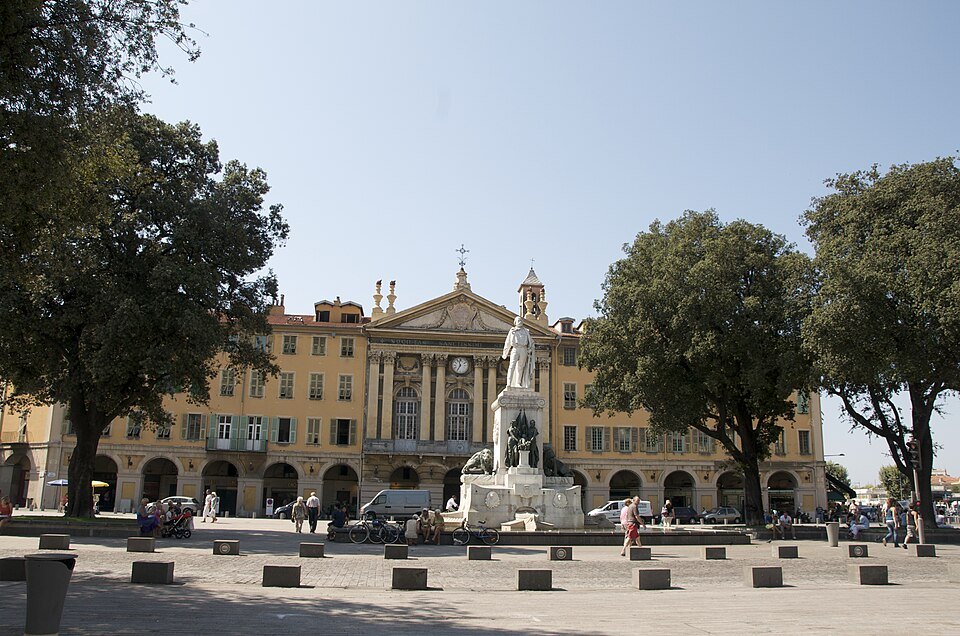
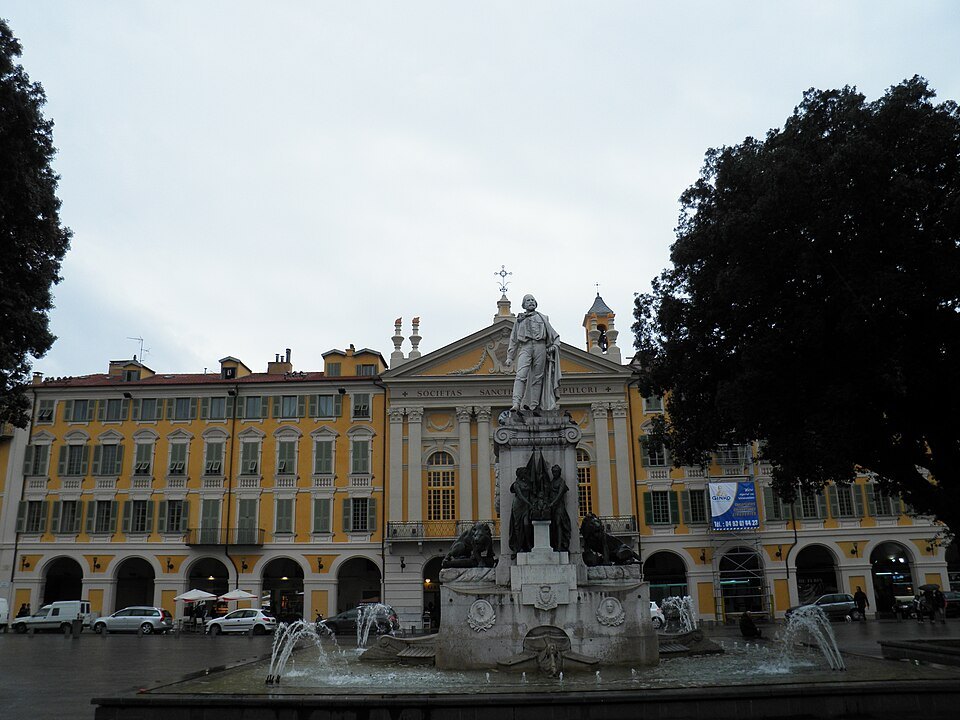
Things moved quickly in 1780, when King Victor-Amadeus III decided to make the road from Turin to Nice usable by carriages. The end of that royal road needed an entrance worthy of it, and the Ticino architect Antoine Spinelli was chosen to design a square plan lined with buildings on arcades. Uniformity was the rule: every building three stories high, smooth facades painted reddish ochre, and window frames picked out in fresco, on the Turin model imposed across the Savoy states. A monumental gate opened the square to travelers arriving from Turin on the north side, and at the opposite end the neoclassical facade of the Chapel of the Holy Sepulchre closed the view.
A square of many names
Its names track the city's changes of ruler. It was Place Pairoliera after the medieval gate, then Place Victor-Emmanuel, known as Piazza Vittorio; under the Revolution, Place de la République, then Place Napoléon. After the Sardinian restoration it became the Place d'Armes, from 1836 to 1860 Place Saint-Augustin, and then Place Napoléon again until 1870. On September 13, 1870, on the prefect's proposal, it took the name of Giuseppe Garibaldi, who was born in Nice in 1807. Around the same time the city government of François Malausséna turned it into a green square, with a large fountain pool in the middle, lawned paths edged with roses, oleanders at the corners, and oaks and eucalyptus shading the benches.
From the beginning it was where everything converged: goods on their way to the port, the great Saint Bartholomew livestock fair from August 24 to September 2, the welcome of visiting sovereigns, and public festivals. In 1882 the first float of the Carnival king passed through it on the way to the Cours and Place Masséna.
Reading the monument
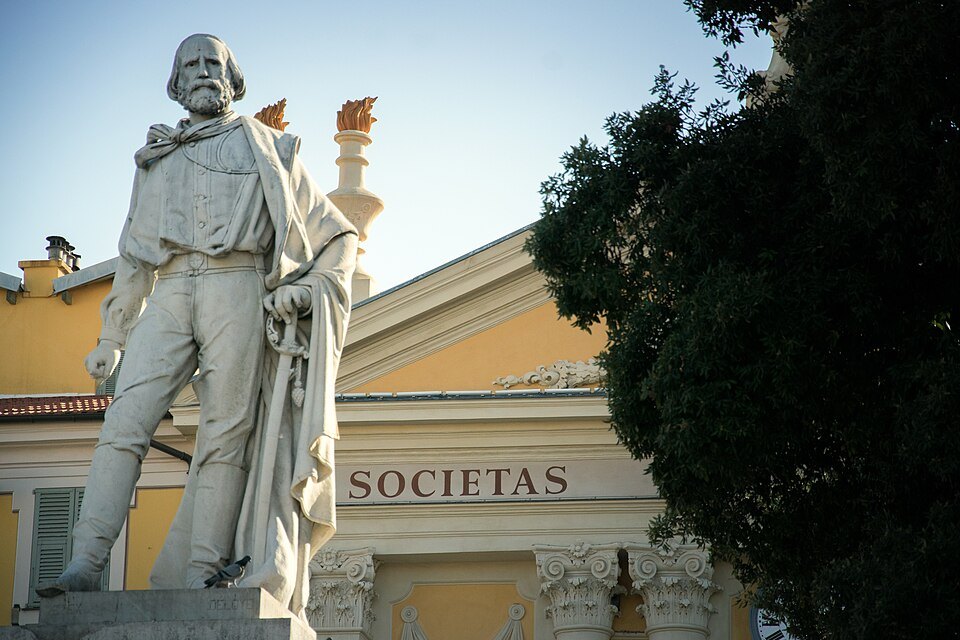
On the day Nice learned of Garibaldi's death, June 4, 1882, the city council voted to put up a monument to him. The sculptor Antoine Étex began it but died in 1888, and Gustave Deloye finished it; it was inaugurated on October 4, 1891. Garibaldi stands in his famous red shirt, right fist clenched, left arm resting on his sword, looking up the old royal road toward Turin.
Below him a bronze group shows France and Italy watching over the infant Garibaldi's cradle, France in a Phrygian cap with a rooster on her flagpole, Italy with the Roman she-wolf on hers, above the inscription To Garibaldi, his native town. Two bronze lions stand for two of his sons, Menotti and Ricciotti, each resting on a cannon: one marked 1860 for the Expedition of the Thousand, the other 1870 for the battle of Dijon in the Franco-Prussian War, where Garibaldi distinguished himself. Ship's prows rise from the pool around the base, a nod to his family's seafaring tradition, and medallions on the front show two of his grandsons, Constant and Bruno; a bronze relief on the back shows Nice among the nations. The monument has been a listed historic monument since 2009.
The square today, and what lies under it
The square measures roughly 123 by 92 meters. When tram line 1 was built in 2007–2008 it was fully renovated and made largely pedestrian; the trams cross it without overhead wires, to protect the view, and the monument was moved eighteen meters south, its pool reduced to a square 17 meters on a side. In March 2012 a two-year restoration of the facades was completed: some twenty fresco painters, working from nineteenth-century photographs, restored the trompe-l'œil decoration on all four sides. On the corner with Boulevard Jean-Jaurès, the Café de Turin, founded in 1908, specializes in seafood.
Under the southwest corner is an archaeological crypt that can be visited, with the remains of the Pairolière tower, the Saint-Sébastien bastion and the old Augustinian suburb.
Sources