What it is
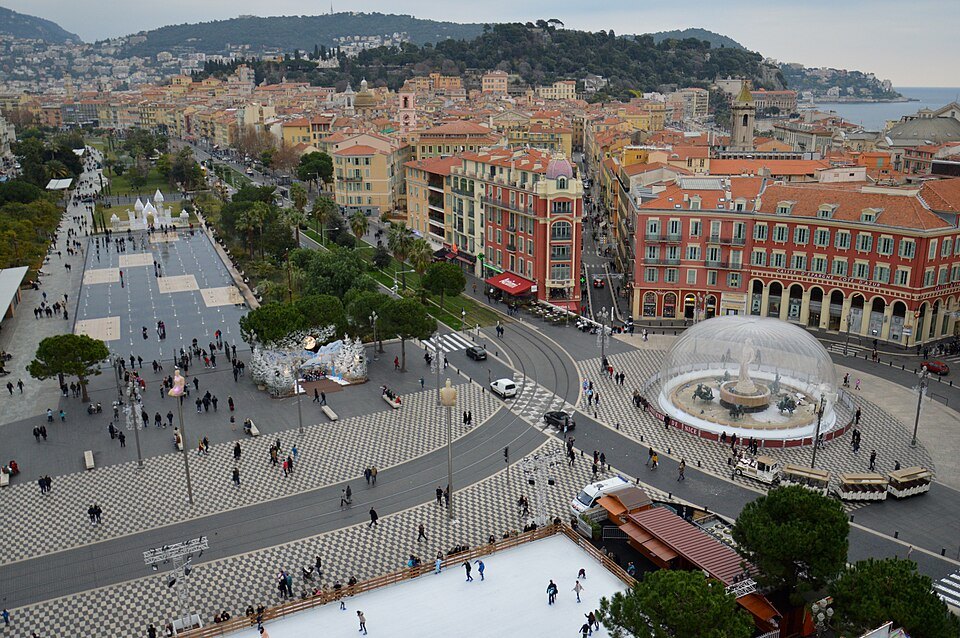
The city's main square, and the hinge of the whole place: the old town on one side, the nineteenth-century French town on the other, the Paillon gardens running through it.
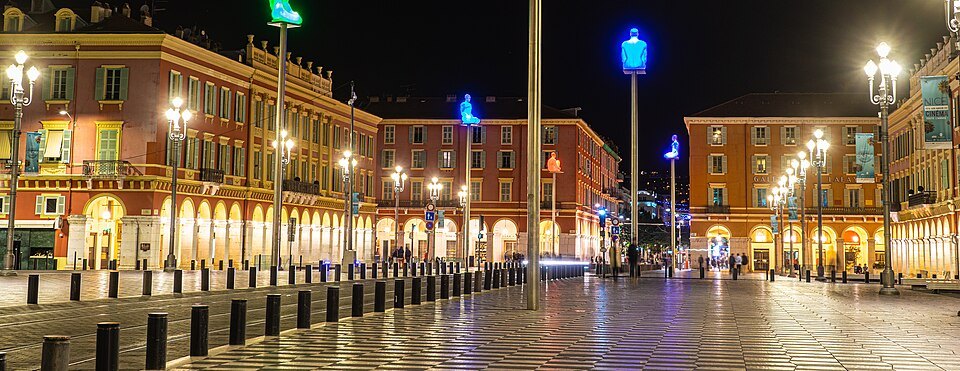
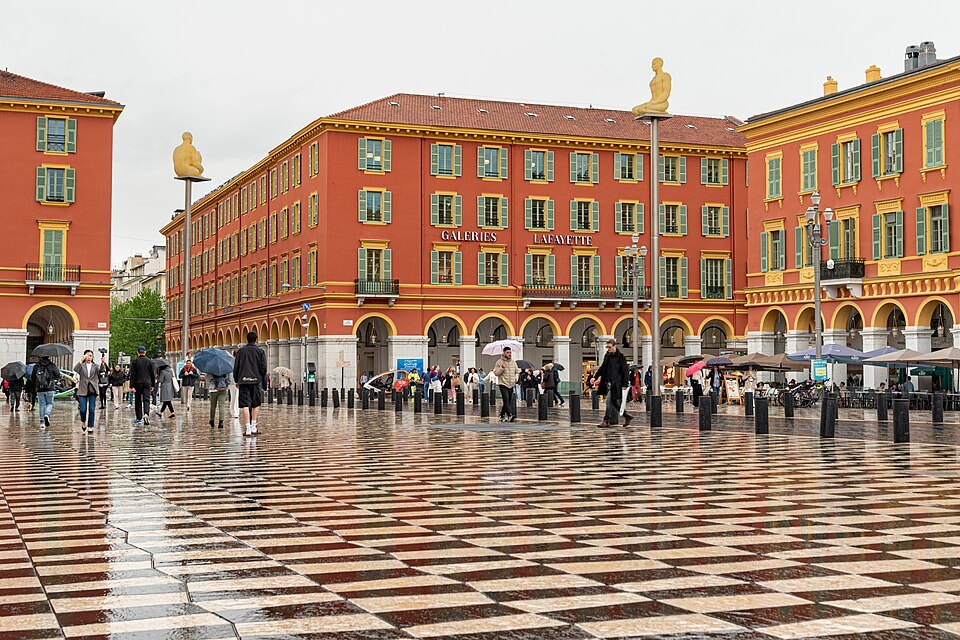
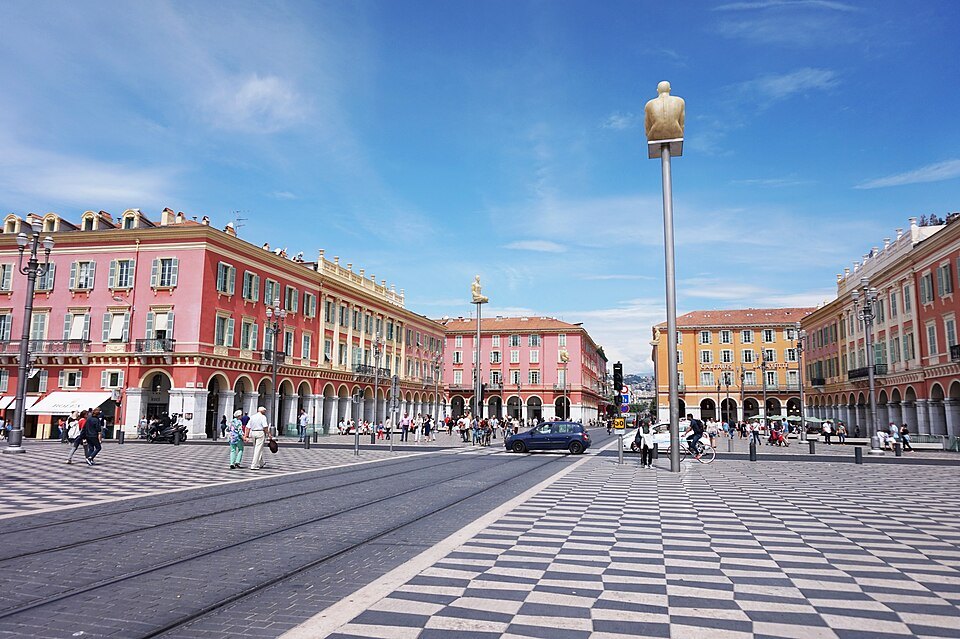
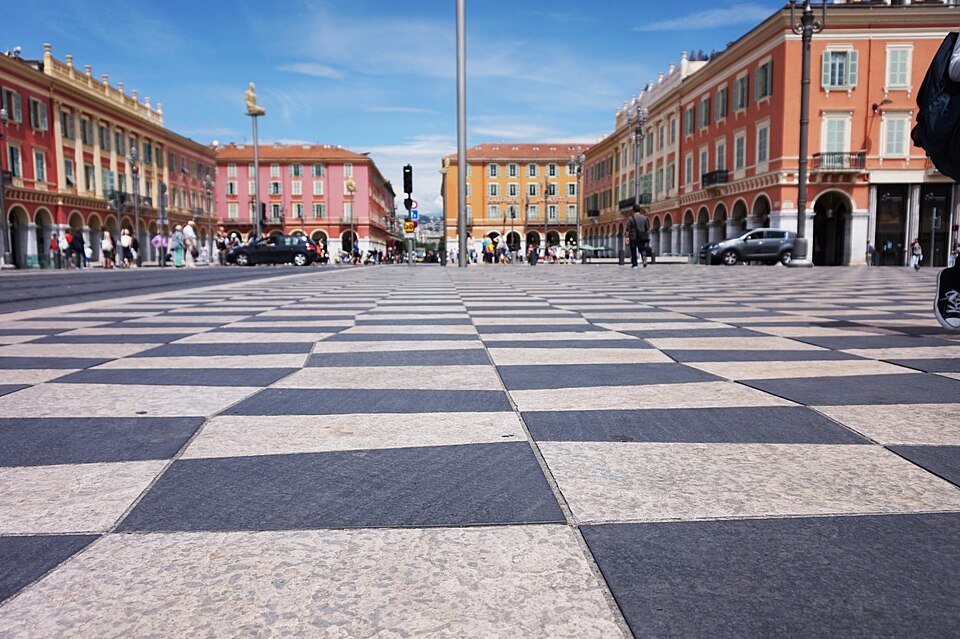
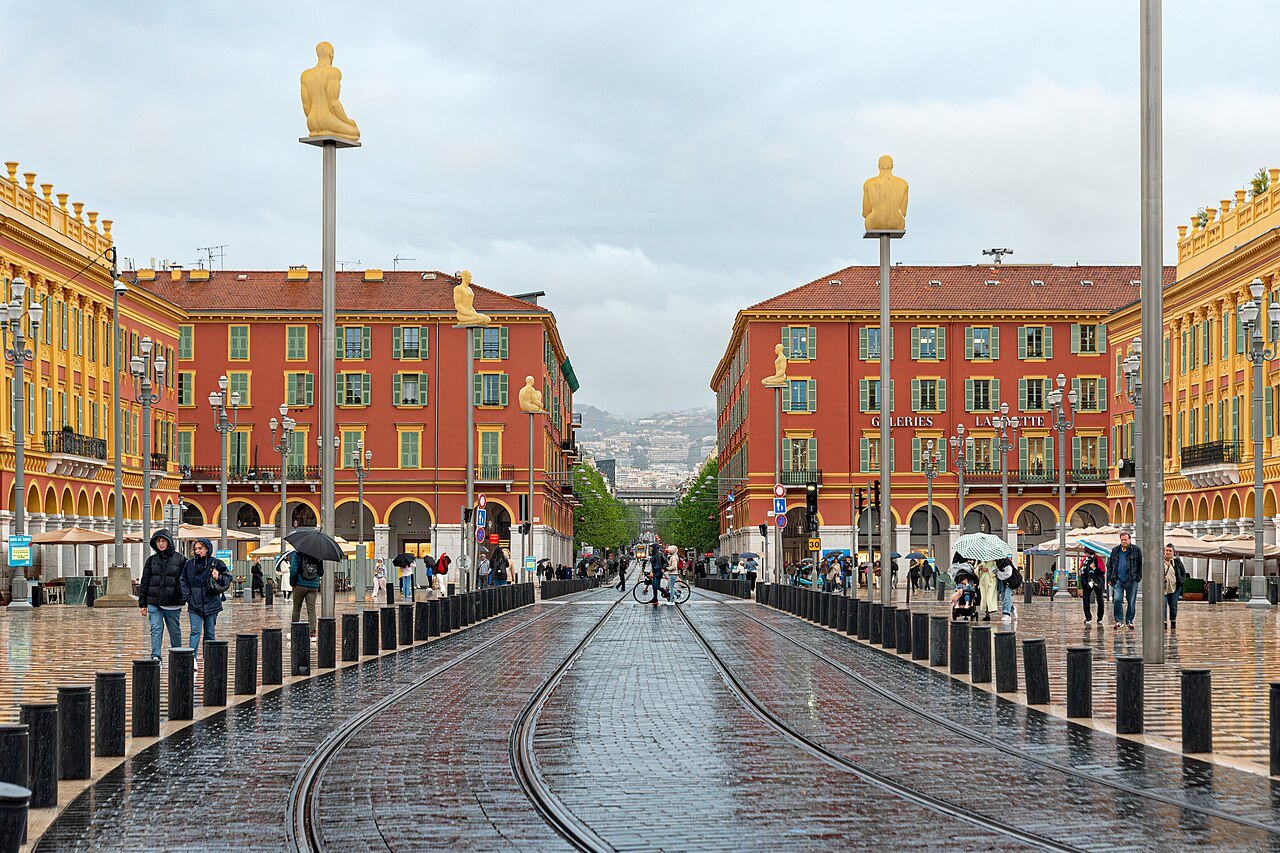
The buildings are deep red ochre with white arcading — a Turin colour scheme, laid out when Nice was still Sardinian — while the paving is a black-and-white chequerboard that reads as unmistakably modern. Standing on it, you can see the join between the two cities.
What is on it
The Fontaine du Soleil stands at the southern end, with Apollo above it. At night the square is lit from below and the chequerboard becomes the brightest thing in the city centre.
The illuminated figures seated on masts above the square are a contemporary artwork and still in copyright, so you will find them written about here and not photographed.
A square planned in Turin's image
Place Masséna grew in stages from the 1820s, modeled on Piazza Vittorio Veneto in Turin, the capital Nice then answered to. It began with a bridge. Until 1824 the only crossing of the Paillon for carts was the old bridge at the edge of the old town; a second one, officially the Pont royal Saint-Charles but known to everyone as the Pont-Neuf, was started in 1820 and finished in 1824. On the old-town side of it a semicircular square, Place Charles-Albert, took shape.
The square on the far bank was the work of the Consiglio d'Ornato, the planning board that guided the growth of modern Nice from 1832 to 1860. A first design was meant to mirror the semicircle, but a church planned at the back of it did not fit, and in 1835 the board chose a square plan by Joseph Vernier, the piazza Quadrata. Floods in 1837 turned the site into a swamp and delayed everything. Vernier's revised project was finally adopted on December 29, 1843, and confirmed by royal letters patent on April 2, 1844.
Why every building matches
The red facades and continuous arcades are not an accident of taste. Vernier fixed the elevation of every building in advance, with 17 arcades on smooth pilasters, and the board imposed it on the owners, down to the grain of the stone in the pillars and the colors of the facades. The result sits halfway between a French apartment house and an Italian palazzo, and it is still treated as a model of urban design. Most of the buildings stood by the 1850s; the one that now houses the Galeries Lafayette department store dates from 1859.
The ground itself stayed in poor shape after the 1837 floods and was only properly finished in 1860, for the visit of Napoleon III after Nice became French. That paving was France's first contribution to the square.
Who Masséna was
The name appears in official documents from 1852. André Masséna was born in Nice, joined a royal regiment in 1775, and rose through the armies of the Revolution and Napoleon to become a Marshal of the Empire, Duke of Rivoli and Prince of Essling, titles taken from his battles of 1797 and 1809. He stayed attached to his home town all his life. After 1860 the French kept his name and quietly dropped the Savoyard ones: the bridge and Place Charles-Albert disappeared into the larger square, and the monument to King Charles-Félix on the Cours Saleya was moved in 1861.
Covering the river
In the nineteenth century the Paillon was an open riverbed, dry most of the year and in flood the rest, used by washerwomen and swimming children and widely seen as an eyesore. Covering it began right here. The garden now called Square Général-Leclerc, covering 4,500 square meters, was built over the river in 1866–1868; its statue of Masséna, by Albert-Ernest Carrier-Belleuse, who taught Rodin from 1864 to 1870, was put up in 1869.
In 1879 a businessman named Omer Lazare offered to pay for covering the Paillon from the square to the sea in exchange for the right to run a municipal casino on top for 80 years. The council accepted on September 17, 1879, and after changes of concession holders the work was finished in August 1883. The covered river also allowed the public garden next door, now the Jardin Albert-Ier, to be extended up to the square in the 1890s. The casino was demolished in 1979, which opened the square up again.
The square today
The rebuilding of the square for the tramway gave it back to people on foot, with palms and stone pines instead of traffic. It is still where Nice gathers: the carnival parade in February, the July 14 military procession, concerts and summer festivals. Above the tram tracks, seven kneeling figures on tall poles make up Conversation à Nice by the Catalan artist Jaume Plensa, installed in 2007; they stand for the seven continents and light up after dark.
Sources