What it is
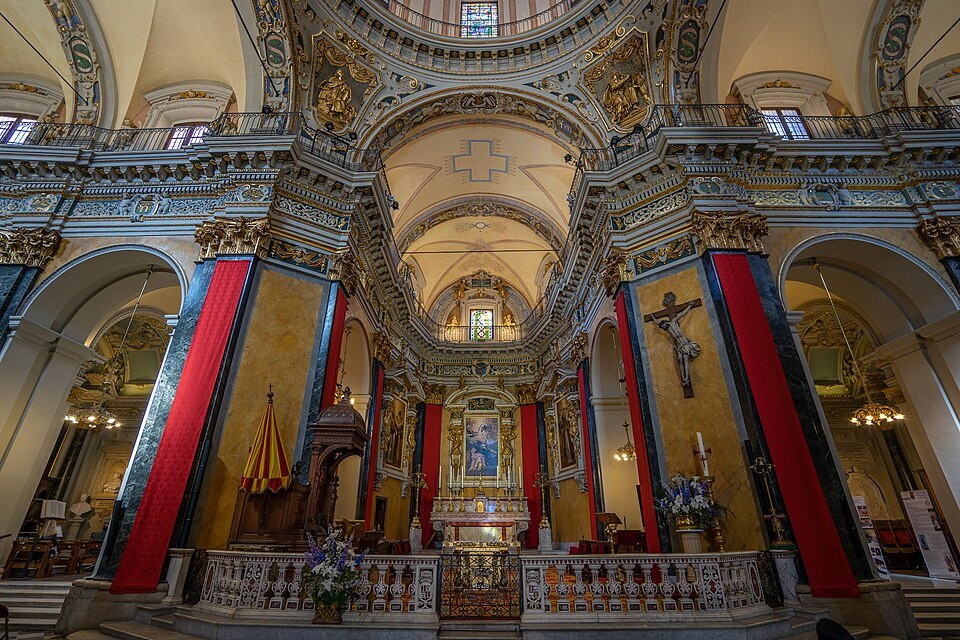
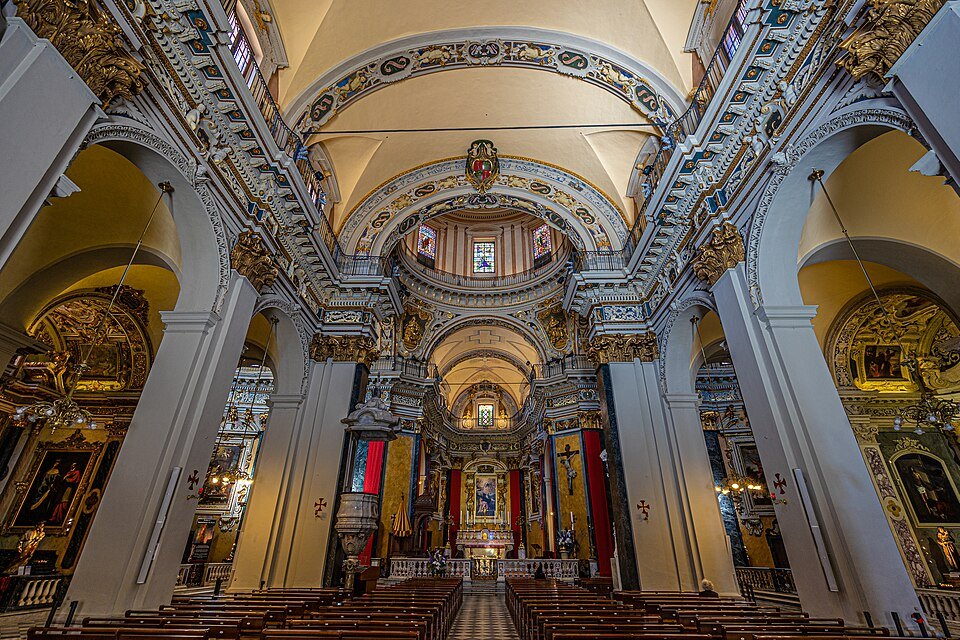
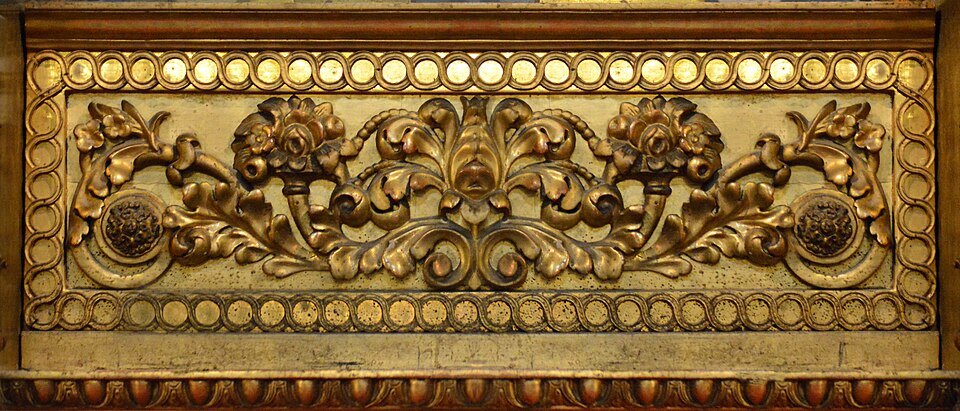
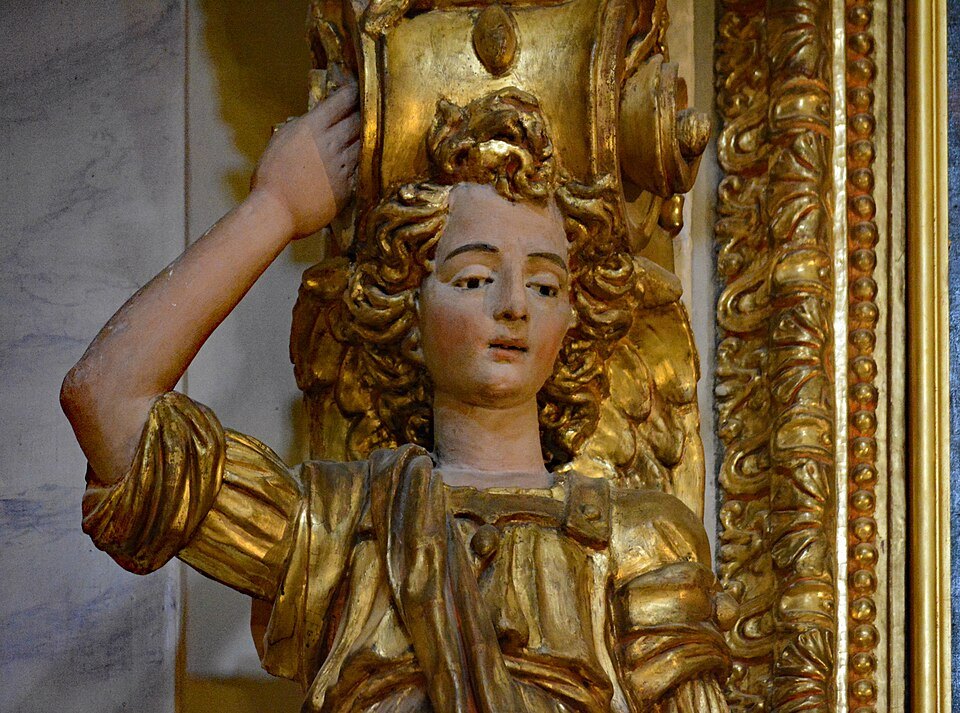
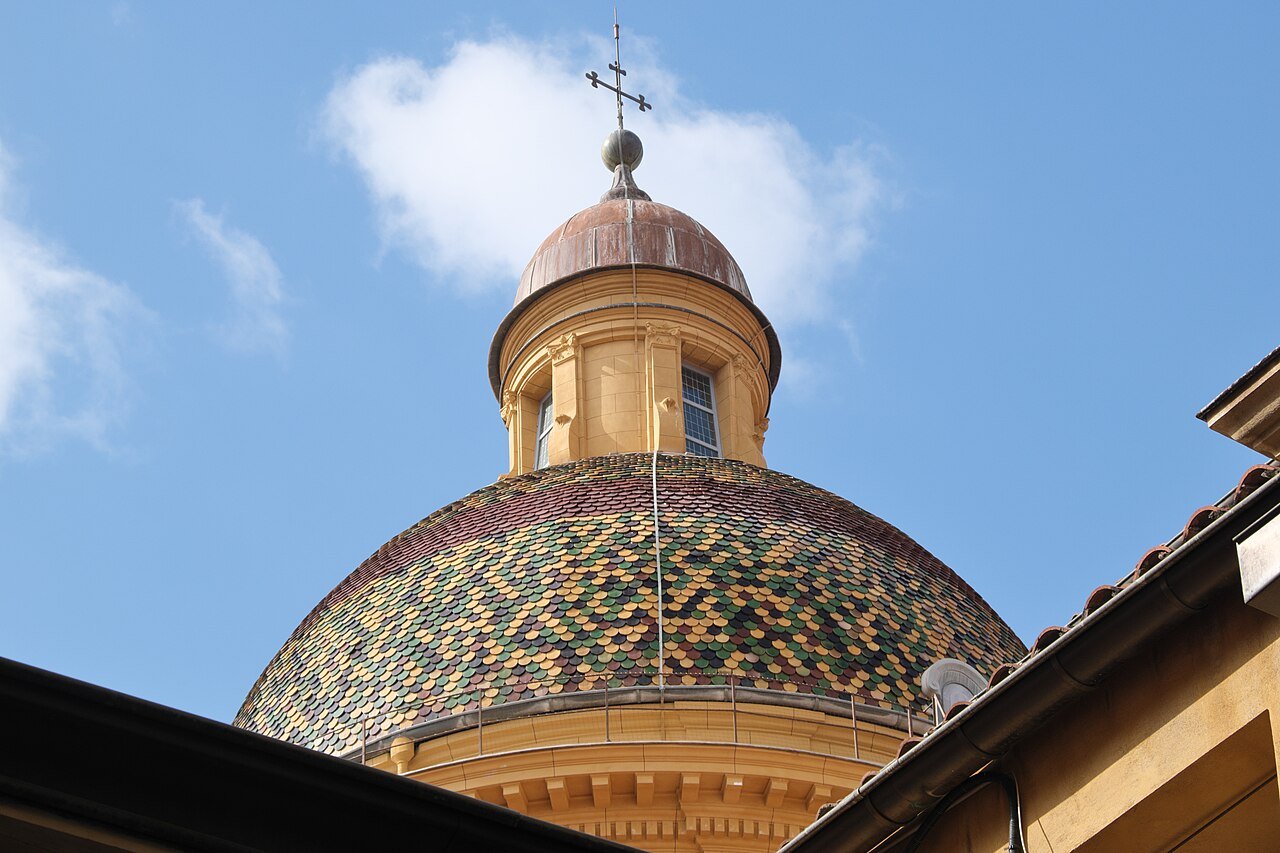
The cathedral stands on Place Rossetti, and it is a genuinely Italian baroque church: a broad ornamented facade, a dome of glazed tiles, and an interior of coloured marble and gilt that is much richer than the plain lanes outside prepare you for.
It is dedicated to Sainte Réparate, the city's patron — a young Christian martyr whose body, the story goes, was carried to Nice by angels, which is where the Baie des Anges gets its name.
Seeing it
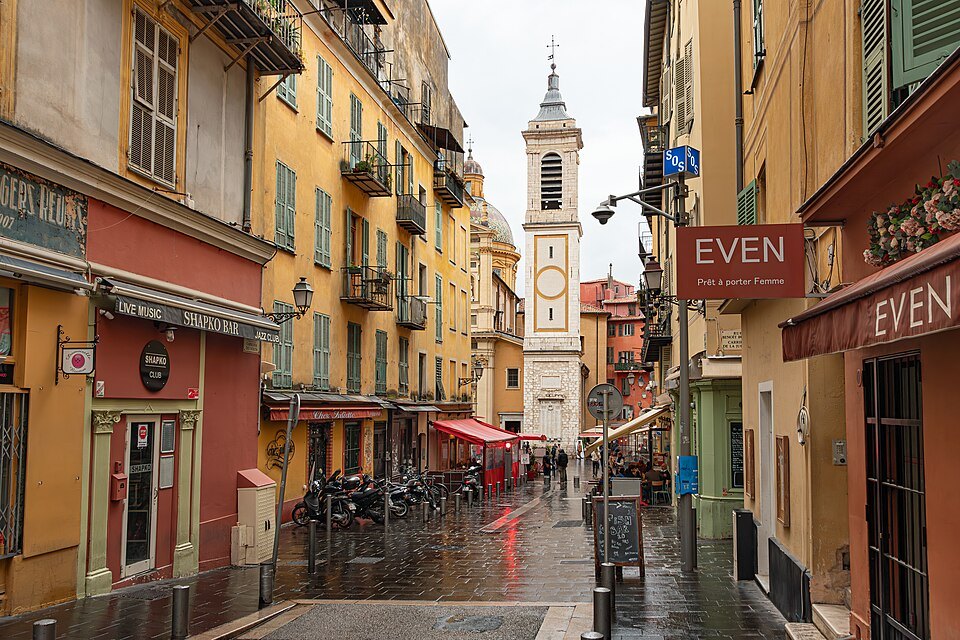
The square is too small for the building. There is no vantage point that takes in the whole facade, and every photograph of it is a compromise — which is itself very Vieux Nice.
The tiled dome is best seen from above, from the castle hill, where it stands out of the terracotta roofs.
Why the cathedral moved down the hill
Nice's first cathedral was not here but on top of the castle hill: Sainte-Marie du Château, whose high altar was consecrated in 1049. As the Dukes of Savoy turned the hilltop into a fortress, the cathedral was cut off from the people who had moved down to the town below. Here, at the foot of the hill, relics of Saint Reparata had been brought from Rome in the eleventh century and a small oratory built for them; it grew into a priory of the Abbey of Saint-Pons and became a parish church in 1246.
From 1531 a series of agreements moved the seat of the bishops down to Sainte-Réparate, and in 1590, at a ceremony presided over by Bishop Pallavicini in the presence of the Duke of Savoy, it was recognized as the cathedral. The old church on the hill was wrecked in 1691, when a French shell exploded the powder store in the keep during the siege.
Excavations on the hilltop have since found the foundations of several cathedrals stacked one on another: an early Christian church of the fifth century, a single nave about 22 by 10 meters; a Carolingian remodeling with a rounded apse; a three-aisled church of the eleventh century; and a larger one from the fifteenth century, known from a drawing made in 1590.
A building that fell on its bishop
The parish church was too small for a cathedral, and in 1649 Bishop Didier Palletis commissioned a new one from the Nice military engineer Jean-André Guibert. Work began with the choir on January 7, 1650. On September 18, 1658, the vault of the nave collapsed in front of the bishop; he was struck on the head and died a few hours later. Building stopped until 1673, the main structure was finished in the early 1680s by the Ticino architect Marc-Antoine Grigho, and the cathedral was consecrated on May 30, 1699.
The plan follows Santa Susanna in Rome: a Latin cross with a dome over the crossing, covered in glazed tiles in the Genoese manner. The bell tower, which partly hides the dome from the square, was built between 1731 and 1757. The facade you see was added between 1825 and 1830, and an apse was added on each side of the choir between 1900 and 1903. The square in front was opened up after 1815 by clearing away houses that hemmed the church in; the last of them came down in 1871.
Inside
The interior is baroque throughout, with ten side chapels: Our Lady of the Seven Sorrows, the Crucifixion, Saint Rose of Lima, Saints Alexander and Bartholomew, the Holy Sacrament, Saint Rosalia and the Virgin, Saint Joseph, Saint Reparata, the Four Crowned Martyrs and Saint John the Baptist. Until the end of the seventeenth century each chapel belonged to a family or a trade guild, which paid for its upkeep, and that is why no two are alike. In 1989 a nativity scene set up in the chapel of Saints Alexander and Bartholomew caught fire, destroying the chapel and the relics kept under its altar.
Above the high altar is a painting of the Glory of Saint Reparata, the young martyr to whom the church is dedicated; her relics have been kept here since 1690. The cathedral has three organs, one on a gallery over the entrance, one in the north transept and one in the choir's rehearsal room.
Its place in the life of the city
The cathedral was classified as a historic monument on August 9, 1906, and raised to the rank of minor basilica in 1949. A full restoration of the interior and the facade began in 2009. It is where Nice comes together at its hardest moments: the funeral of the Formula One driver Jules Bianchi was held here in 2015, and on July 15, 2016, the day after the attack on the Promenade, a mass for the victims. In 2021 the bell-ringing system was restored, and on May 24 that year the great bell swung and rang for the first time in a hundred years.
Sources