What it is
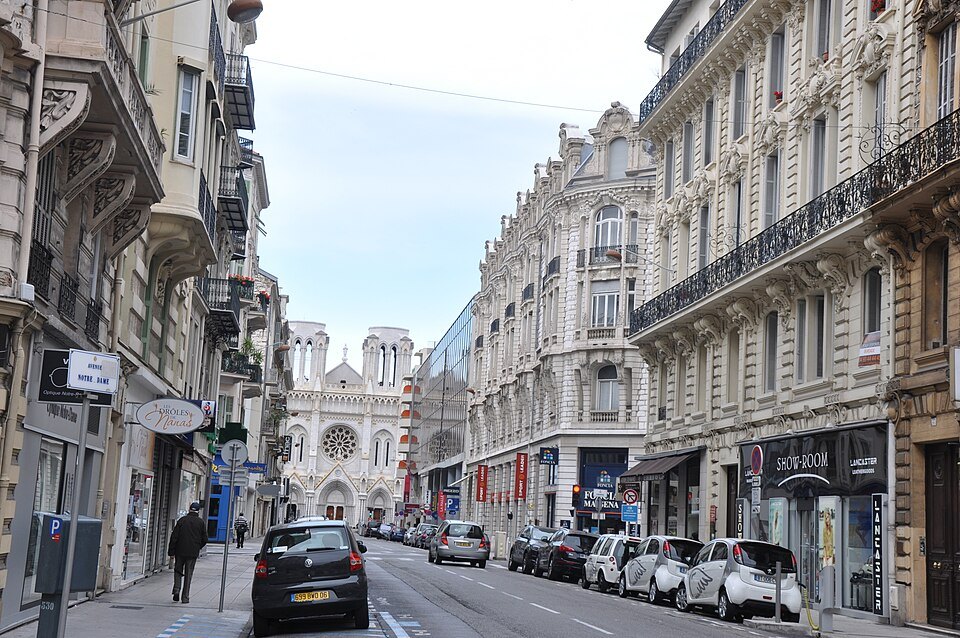
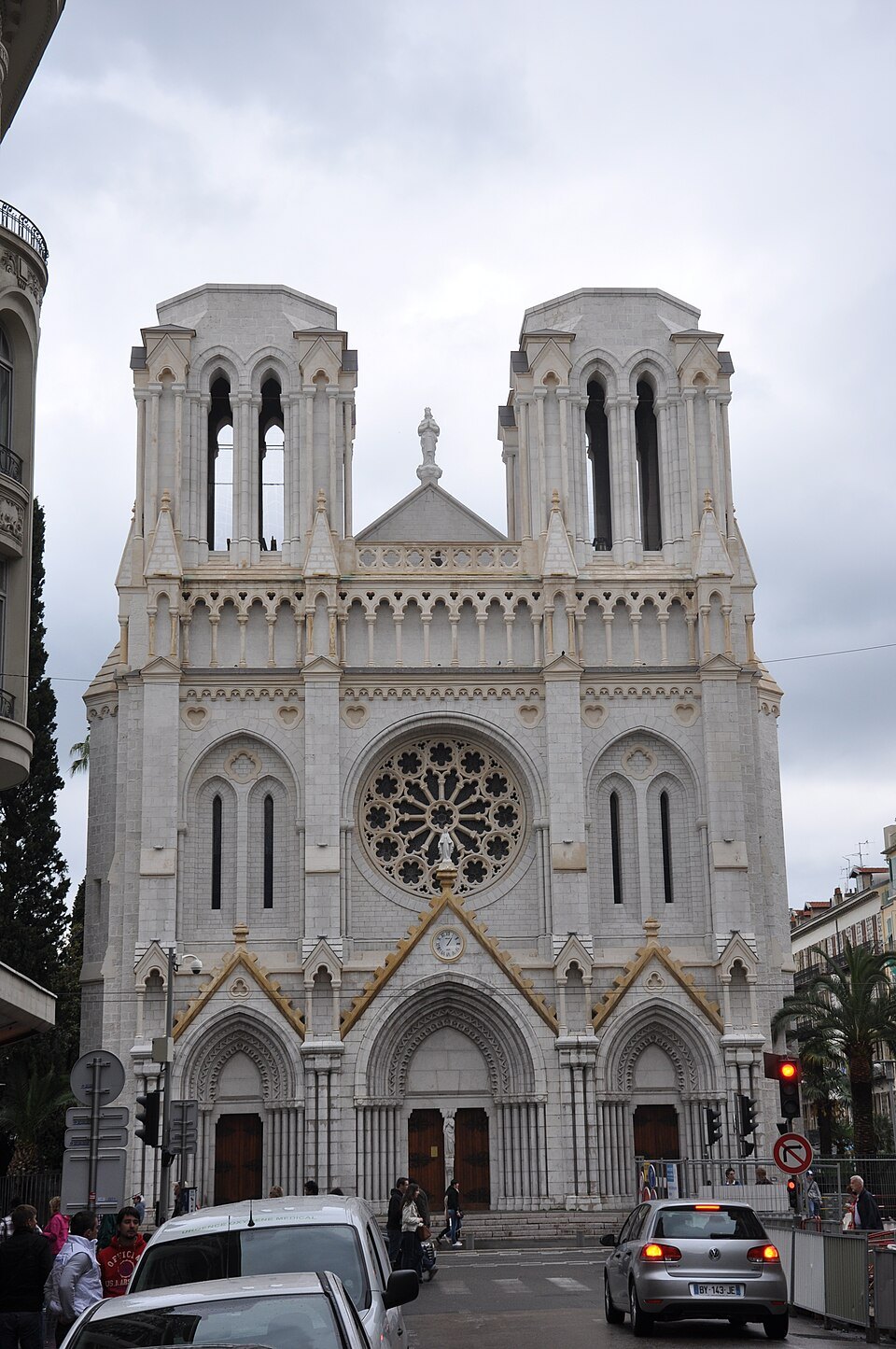
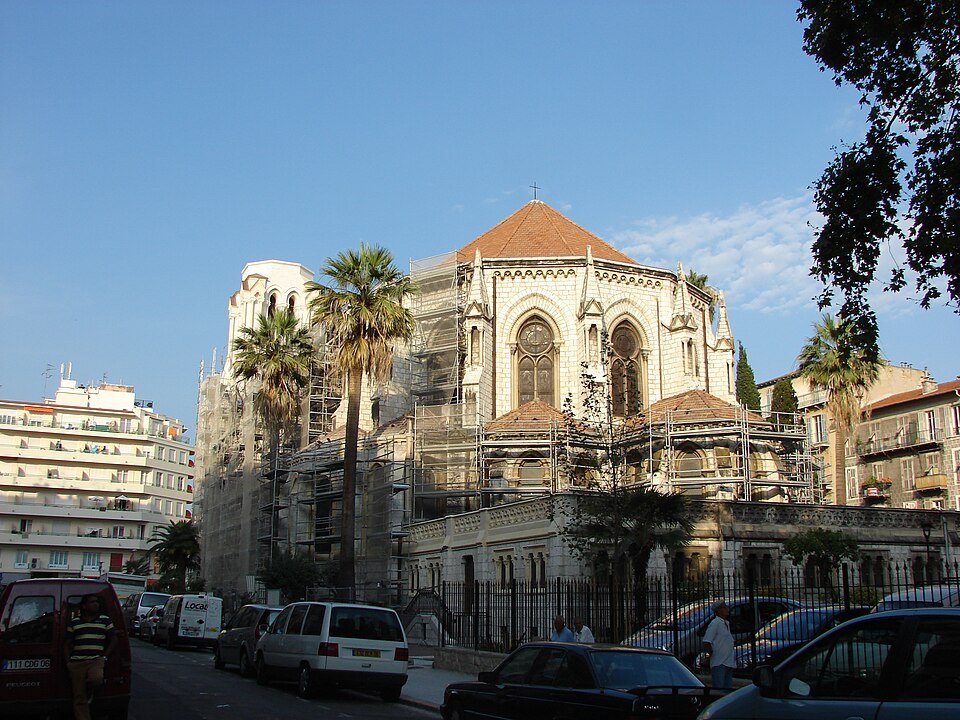
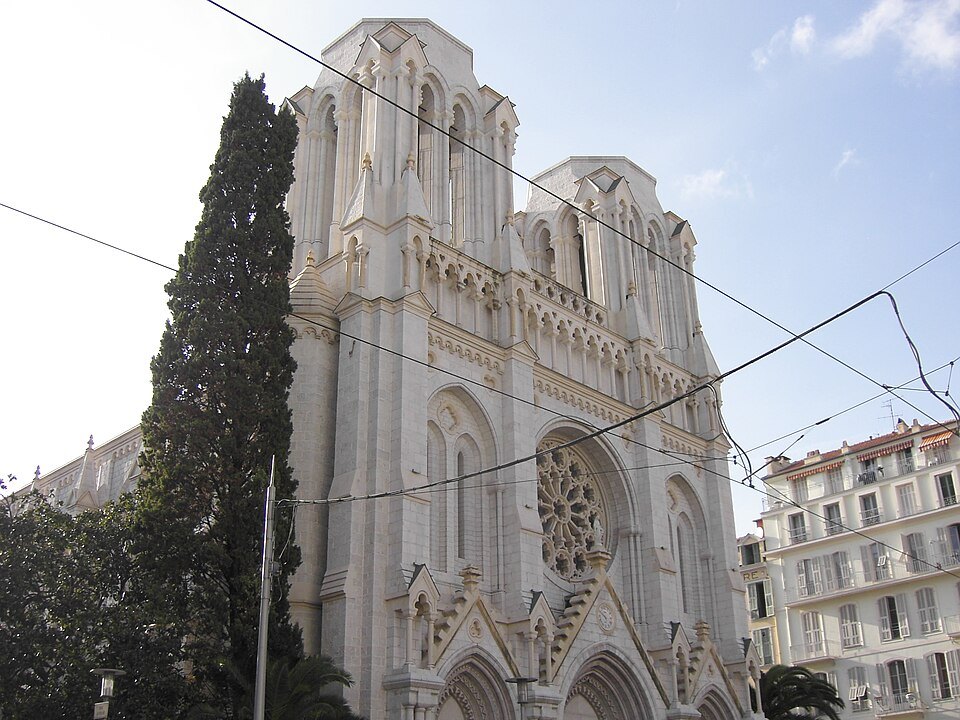
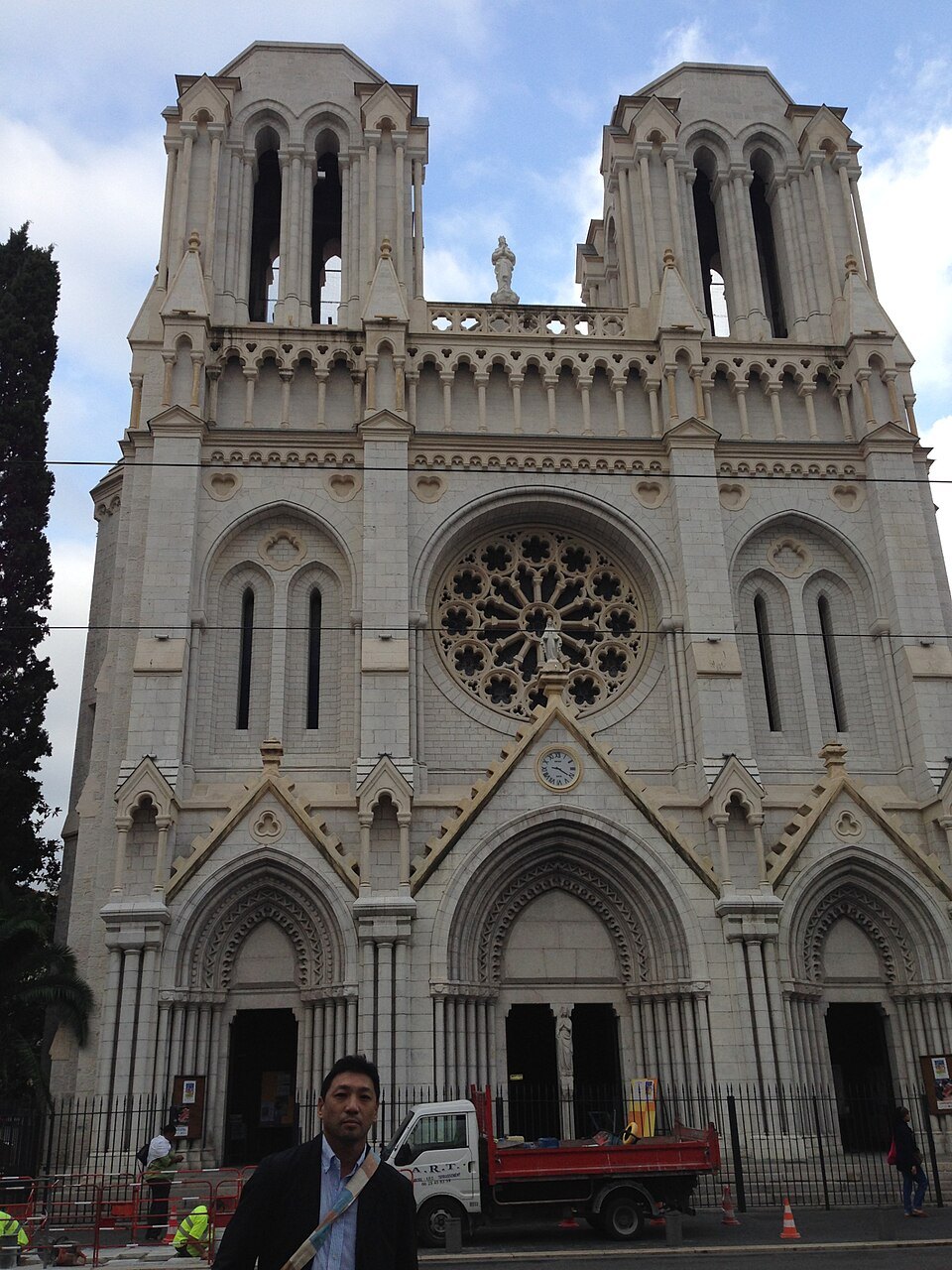
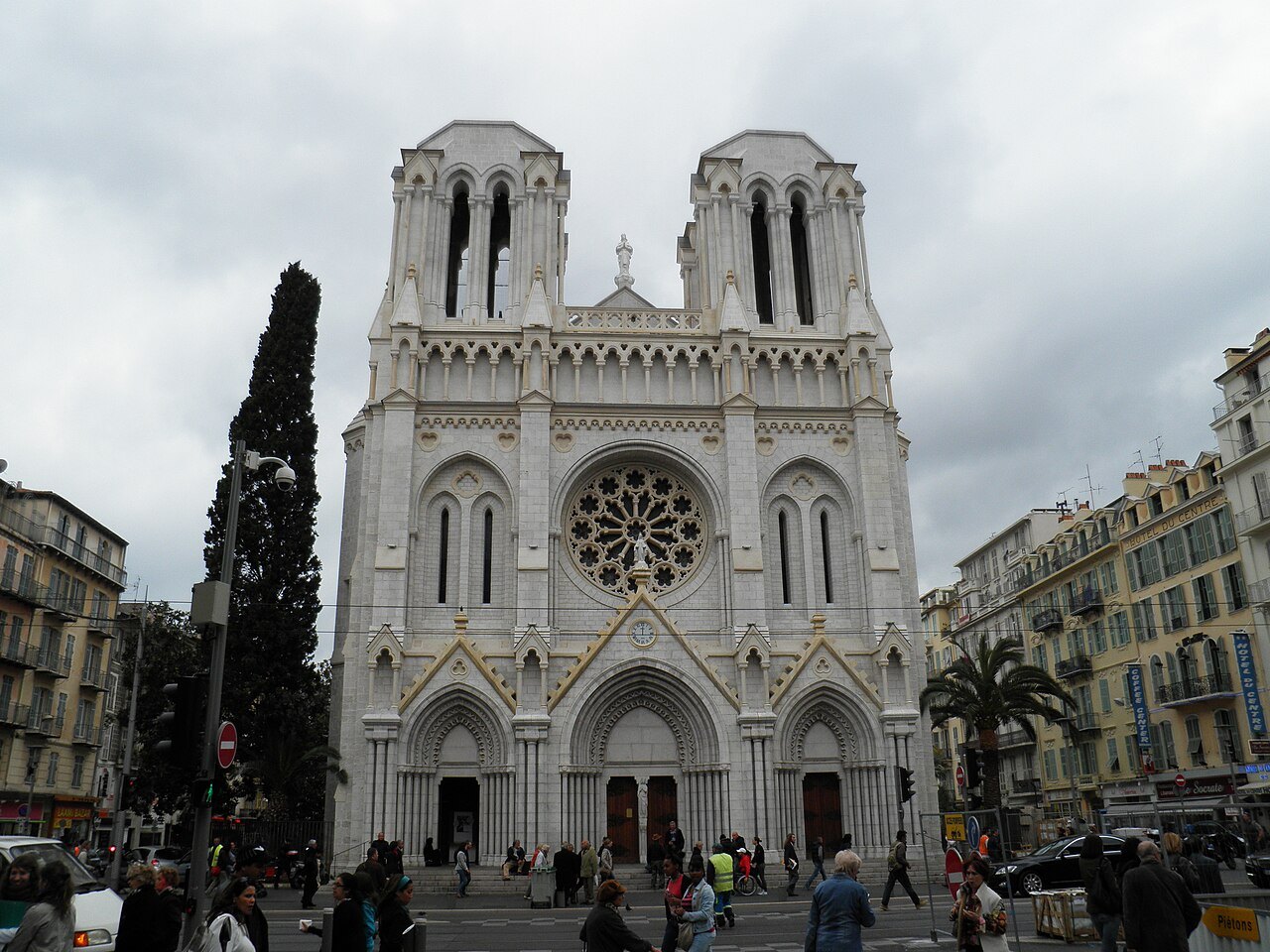
The largest church in the city, standing on the main avenue through the new town. It is neo-Gothic — twin square towers, a rose window, a nave built for a growing French city rather than an Italian one.
That is the point of it. It went up in the years around the cession of 1860, in the French style, on the French side of the river, while the baroque cathedral stayed where it was in the old town. The two buildings are an argument about what Nice was going to be.
Seeing it
The facade is best from across the avenue. Inside it is calm and unusually cool, which on the walk up from the seafront is worth knowing.
A French church for a newly French city
The basilica of Notre-Dame-de-l'Assomption is the largest church in Nice, though not its cathedral. Work began in 1864, four years after the County of Nice passed from the Kingdom of Sardinia to France, and the choice of style was deliberate: at the time Gothic architecture was considered characteristically French, and the authorities wanted to give the city a French face. The design came from the Lenormand family of architects; the English and French accounts differ on whether the credit belongs to Louis Lenormand or his son Charles, and on whether the building was finished in 1868 or 1879.
It borrows from the cathedrals of Angers and Paris. The front is dominated by two square towers framing a large rose window with scenes of the Assumption of the Virgin. The church was consecrated on March 12, 1925, and Pope Paul VI raised it to the rank of minor basilica on April 16, 1978.
October 29, 2020
On October 29, 2020, three people were killed inside the basilica in an Islamist terrorist attack. On November 1, before the All Saints' Day mass, the Bishop of Nice, André Marceau, led a rite of reparation in the church.
The avenue it stands on
The basilica's street, Avenue Jean-Médecin, is the main shopping street of Nice, and people simply call it the Avenue. It was laid out in 1864 along a natural valley, the Vallon Saint-Michel, running north from Place Masséna in line with the Pont-Neuf, following the town plan drawn up under the Consiglio d'Ornato before 1860. Its names tell the story of the century: Avenue du Prince-Impérial under the Second Empire, whose government helped pay for it; Avenue de la Gare from 1870, because it led to the station opened in 1867; Avenue de la Victoire from 1918, a name chosen at a council meeting held on the day of the armistice; and Avenue Jean-Médecin from 1966, after the mayor who ran the city from 1928 to 1943 and again from 1947 to 1965.
The carnival parades used to come down the avenue to Place Masséna, but the floats no longer fit since the tramway and its power supply were installed. From 2003 to 2007 the street was rebuilt for tram line 1, and since December 2008 it has been almost entirely pedestrian, apart from the trams. After dark, thousands of blue diodes set into the middle of the street light up, a work by the light artist Yann Kersalé.
Buildings to notice along the way
The lower end, toward Place Masséna, is the more elegant and the more touristy; the upper end is more everyday. The big banks built their Nice headquarters here: the Crédit Lyonnais building of 1890, designed by Sébastien-Marcel Biasini, and the BNP Paribas building of 1921 by Charles Dalmas. The Société Générale branch on the avenue became famous in 1976, when Albert Spaggiari's gang robbed it. The six-story Belle Époque Riviera building of 1913 now holds the Fnac store, a little lower is an Art Deco building used by Monoprix, and at the bottom the Galeries Lafayette, here since 1916, occupy a red-ochre building with Turin-style arcades.
One more story belongs to the arcades. Walking under them in July 1947, the Nice composer Henri Betti came up with the first nine notes of the song that became the international hit C'est si bon.
At the top of the avenue: the station
Walk north past the basilica and the avenue ends at the railway, near the main station, Nice-Ville, known locally as the Gare Thiers. The first trains reached a temporary station here on October 18, 1864, on the line from Toulon, and the passenger building was inaugurated in 1867 in what was then almost open country. Its Louis XIII style, borrowed from the public buildings of Paris, was meant to give the southern city a Parisian look and to tie it to the imperial capital. The architect Louis-Jules Bouchot designed a front of red brick and dressed stone under a central pavilion with a large clock; inside, the great hall is paneled in oak beneath a richly decorated dome. The line was extended to Monaco in 1868, and in 1928 the line to Breil-sur-Roya, up into the mountains, began here.
Sources
- Basilique Notre-Dame-de-l'Assomption de Nice — Wikipédia (French)
- Notre-Dame de Nice — Wikipedia
- Avenue Jean-Médecin — Wikipédia (French)